


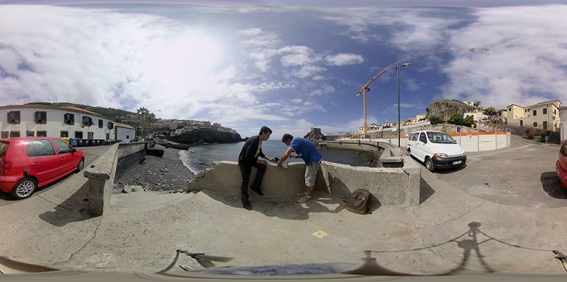


Bailinha - o mestre calafate * 2018
Museu da Imprensa da Madeira (Madeira, Portugal)
Bailinha - O Mestre Calafate [Bailinha — The Master Boatbuilder] is a 360º VR film by António Baía Reis that operates simultaneously as documentary portrait, immersive ethnography, and cultural advocacy. The work invites the viewer into the lived spaces of Jorge Oliveira (“Bailinha”), a master boatbuilder from Câmara de Lobos (Madeira), whose craft, authorship, and livelihood are quietly threatened by the collapse of fishing economies and the accelerating tourist redevelopment of the coastline.
At the center of the film is Bailinha’s paradox: in the late 1990s, he led the construction of a full-scale replica of Christopher Columbus’ ship Santa Maria, now a touristic landmark sailing daily from Funchal, yet his own working life became precarious, his workshop repeatedly targeted for removal, and his contribution increasingly displaced from official narratives. The film approaches Bailinha not as folklore, but as a living archive: a man whose hands carry a maritime lineage, and whose future depends on whether that lineage is allowed to remain visible, spatially present, and transferable to younger generations.
Baía Reis developed the project as arts-based research through rapid, relational fieldwork in Madeira, in collaboration with Michelle Kasprzak (contemporary art/curating) and Justin Pickard (ethnography/innovation studies). The process combined interviews, place-based observation, and an opportunistic documentary logic shaped by the constraints and ethical demands of 360º production. Rather than “cover” Bailinha’s story through conventional frames, the team constructed a spatial narrative: the bay, the workshop, the ship’s deck and hold, and the harbor function as narrative engines. In VR, the viewer is not shown the story; they are positioned inside it, asked to look, to linger, and to sense the density of place as biography.
Formally, the film is built from a sequence of long, contemplative 360º scenes. The workshop, filmed before it was later sealed and demolished, becomes an immersive relic, a disappearing site now preserved as an experiential record. A key movement of the film unfolds onboard the Santa Maria, where Bailinha shares the ship’s construction story with a group of young people from Malvinas, reframing the touristic spectacle as an intergenerational classroom. Another intimate scene shows Bailinha working alongside a teenage boy, Humberto, suggesting a future where craft survives through apprenticeship rather than nostalgia.
Sound and voice operate as the work’s emotional spine. Baía Reis performs the voiceover, weaving Bailinha’s life story with Madeiran poetry to evoke the island’s oceanic psychology, desire, distance, and endurance. The soundtrack draws on Carlos Paredes’ Portuguese guitar compositions, mobilizing an instrument historically tied to Portuguese cultural identity and political resonance. Together with ambisonic environmental sound, the film builds an immersive listening space where intimacy and spatial presence become inseparable, less a “score” than a method for holding attention, slowing perception, and intensifying witness.
The project was designed to extend beyond the headset into the civic sphere. The film premiered in 2019 at the Madeira Press Museum, accompanied by a public talk and community discussion with local residents, youth, educators, and a representative of the Câmara de Lobos municipality. Audience responses repeatedly returned to the same discovery: VR made the story feel closer, more real, and more ethically urgent, an encounter with Bailinha’s spaces that conventional documentary distance rarely affords. The premiere functioned as a local platform of recognition, positioning the work as a tool for cultural visibility and social acknowledgement.
Bailinha — O Mestre Calafate argues that immersive media can operate as cultural care: a way to preserve endangered knowledge, to challenge asymmetries of credit and visibility, and to stage an ethics of attention around working lives that tourism often consumes while erasing the makers. Here, VR is not spectacle, it is proximity. It asks what a community loses when it modernizes its landscape by displacing the very hands that built its heritage.
MEDIA: